Building High-Performing Teams
Building High-Performing Teams” is a modular eLearning course built to help organization leaders transform individuals into cohesive, trusting, and high-impact teams.
Learning Context and Challenge
Today’s complex world requires modern teams to operate in environments shaped by competing priorities and ongoing tension. Research consistently shows that only about 23% of employees worldwide are engaged at work — meaning roughly three in four people on any given team are not contributing at their full potential. There is also evidence that organizations spend approximately $356 billion annually on leadership development globally, yet 75% of HR professionals say their leadership development programs are not very effective. According to this data, low engagement can cost organizations and teams with lower productivity compared to highly engaged teams.
This course starts from the idea that cohesion is not about eliminating differences. It is about creating conditions that allow people to navigate them productively — a capability that every team member, not just those in formal leadership roles, can learn to recognize and build.
The solution
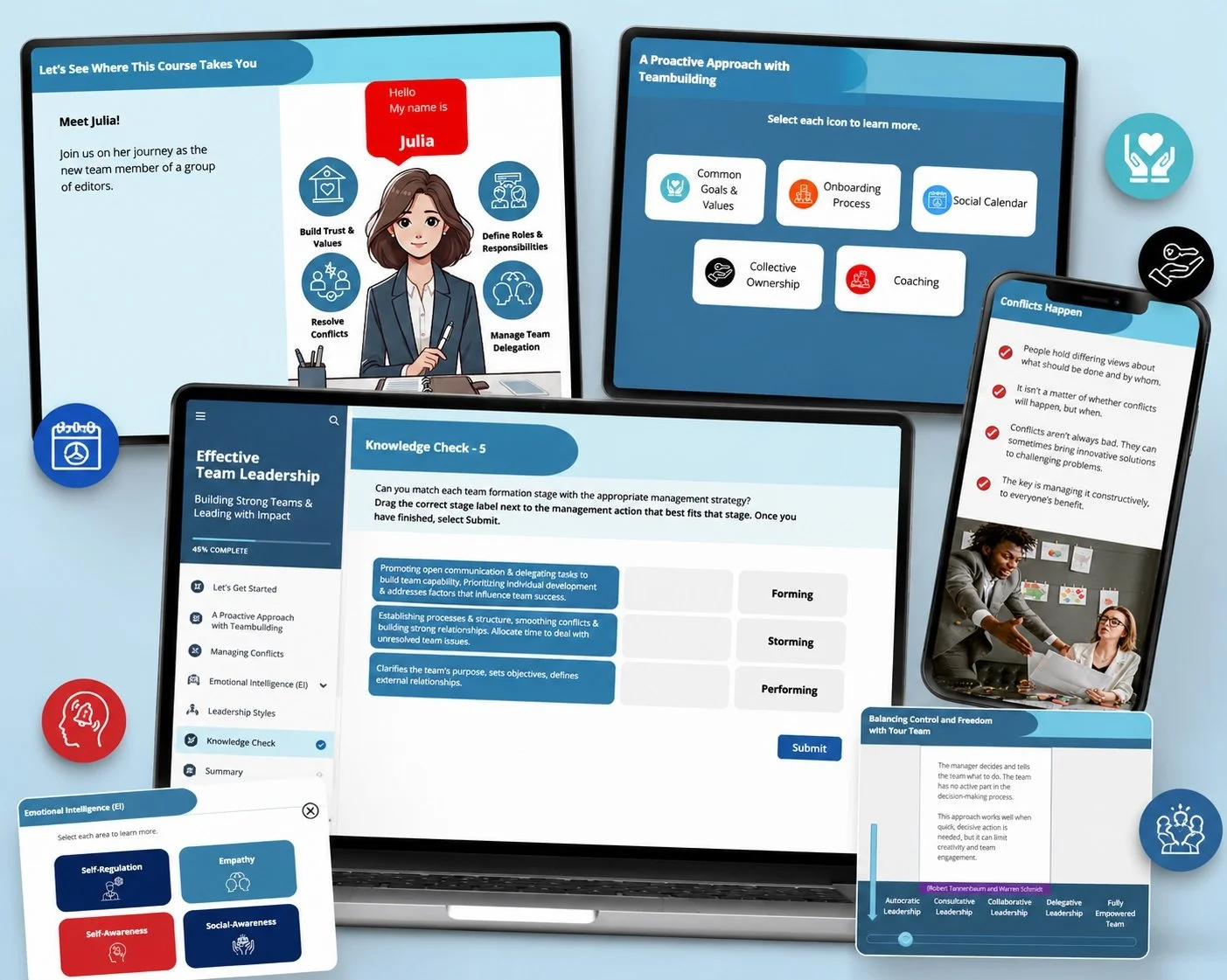
In order to address the challenge, I decided to develop a scenario-based e-learning course in Articulate Storyline that allows active decision-making with visible consequences. In this way, professionals go beyond knowledge acquisition towards building skills aligned with actual problems in real organizational contexts. To achieve this impact, I incorporated:
Branching scenarios
Audio narration and voiceover for every slide
Interactive elements and assessments
Micro-learning videos and animations
Navigation menu and accessibility features
Final evaluation
These components allow for an immersive experience aligned with real-world challenges and opportunities for building self-sustaining, successful teams.
My Process
To propose the best solution, I used ADDIE model. After collaborating with the SME to get insights on how the team dynamic challenges play out in daily operations, I developed an action map using Miro. During the action mapping process, attention to the root problems helped set the main goal: fostering a diagnostic lens to identify unproductive behaviours. A secondary goal was to improve leadership skills to lead through tensions and difficult conversations.
Based on this foundation, I then developed a detailed text-based storyboard which served as the blueprint for the project. My goal was to immerse learners in a simulated real-world experience where they would encounter different situations and team behaviours, and choose how to respond. All the situations had a correct choice and two or three consequences.
To replicate the real-life situation, I introduced a character Called Marcus, an experienced project lead who has recently been promoted with a dynamic team to lead.
Visual Mockups
To guide the production process and maximize compatibility, I developed a mood board to define a visual language to stay consistent with the organization’s brand. After that I interacted on wireframes and mockups to finalize the visual layout for the slides.
I used the fonts and main colours to create a sense of harmony and connection for the audience. I also choose accessible color choices to ensure the content was easy to read on screen.
Full Development
After developing the storyboard, I developed and organized the visual assets and components (such as images, icons, symbols, characters) that needed to communicate certain ideas using Adobe creative Suite and AI-enabled tools. I then developed the course in Articulate Storyline.
Module Screenshots